The best co-development relationships are not built around handing off disconnected tasks. They work when an external team understands the goal, owns a meaningful piece of the outcome, and has enough context to make good decisions along the way.
Devhouse has worked inside several different versions of that relationship. On Aliens: Fireteam Elite, that meant owning the design and production of a complete horde map. For Madden and College Football, it meant supporting an ongoing animation production lane across multiple AAA titles. On SpongeBob Party, it meant taking on engineering, art, and design to build and ship a complete experience with Epic Games and Paramount.
Give Ownership a Clear Boundary
A co-development partner is most useful when the team owns something coherent.
That might be a feature, a level, an art pipeline, a platform release, or another well-defined production lane. Clear boundaries let the team understand dependencies, identify risk, and make decisions without asking the client to prescribe every implementation detail.
Aliens is a good example. The goal was not a list of unrelated environment tasks. Devhouse owned a playable horde map and could think about level flow, verticality, lighting, combat readability, and integration as parts of the same result.
Ownership Can Scale With the Work
That boundary does not always need to be a single feature.
Our EA Sports work became an ongoing stream of animation production across Madden and College Football, including more than one hundred animated reveals in a year. In that environment, ownership meant understanding the expected quality bar and delivering consistently enough for the relationship to continue across multiple titles.
Different projects need different levels of autonomy. What matters is that responsibility is clear.
Stay Close to the Decision
Ownership works best when the people doing the work understand why a decision matters.
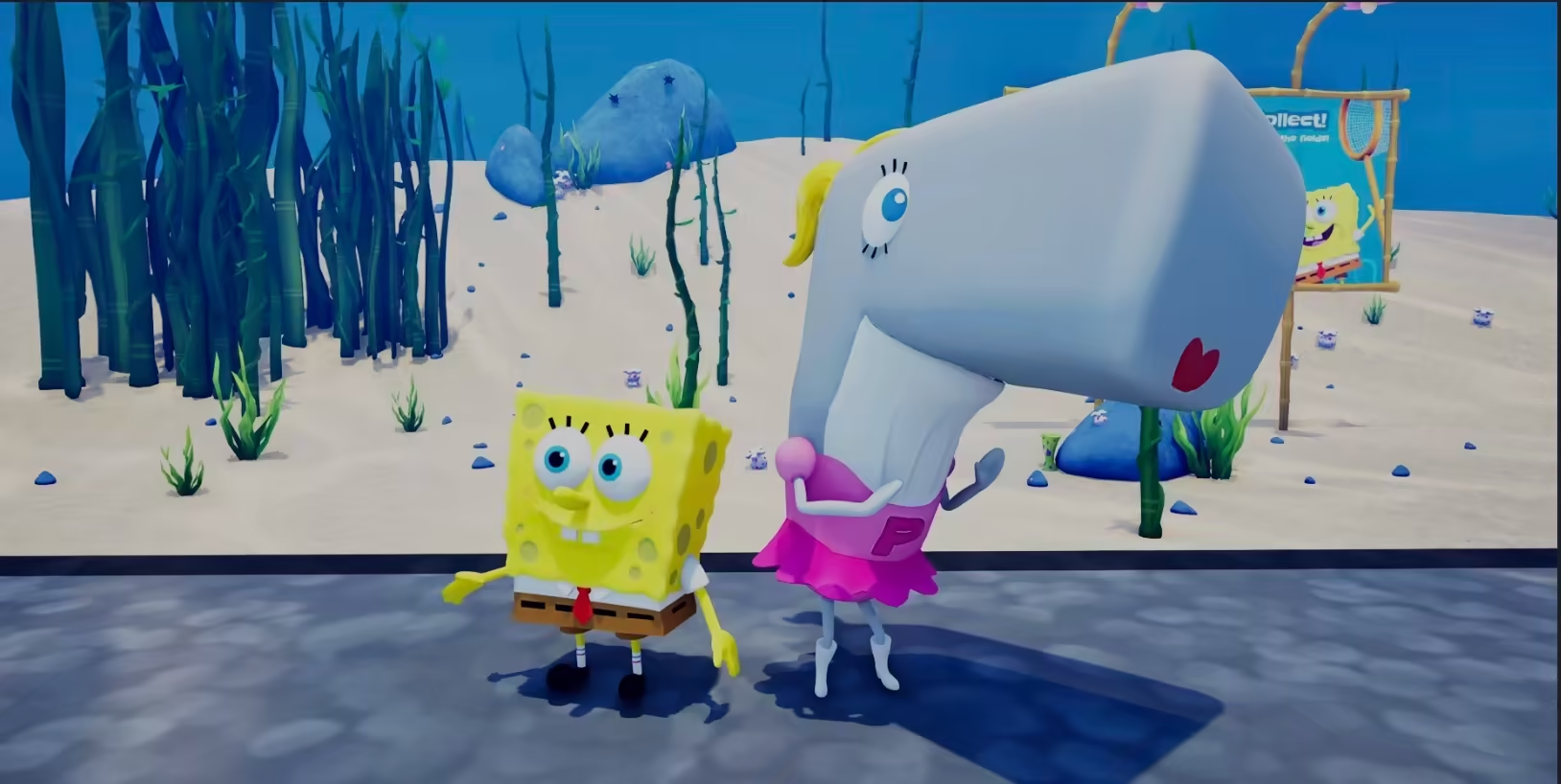
On licensed projects such as SpongeBob Party, that meant working within Paramount's IP guidance while continuing to solve design, art, and production problems internally. When outside approval was required, the team could surface the specific question instead of sending every decision back upstream.
That shortens the distance between context and execution and keeps the client focused on the decisions that actually require their input.
Own the Outcome, Not Just the Task
A strong co-development partner should create more than additional capacity. The team should be able to identify risks, understand tradeoffs, and protect the same player experience as the internal developers.
That requires trust, and trust is earned through consistent delivery. It grows when risks arrive before surprises, questions come with context, and the partner can be relied on to carry a piece of the game from problem to result.
The goal of co-development is not to add another layer to production. It is to give the project another team capable of owning the outcome.